For thousands of years acupuncture has played a central role in protecting the health of the Chinese people. Today it is one of the fastest-growing forms of complementary care in North America and Europe.
Ancient origins
Some four thousand years ago, healers used sharpened stones called bian for curative purposes — the earliest ancestors of the acupuncture needle. As society moved into the Bronze and Iron Ages, metal needles replaced stone, and the instruments were refined over centuries.
Moxibustion likely began with fire itself: people warming themselves noticed that heat on certain areas of the skin relieved pain or illness. Moxa (mugwort) leaves were eventually chosen because they light easily and give a mild, penetrating heat.
The classic Huangdi Neijing (the Yellow Emperor’s Canon of Medicine) set down the foundations of Traditional Chinese Medicine: Yin and Yang, the five elements, the organs, the channels and collaterals, Qi and blood, diagnosis — and the acupuncture points and needling methods still used today. Europeans first learned of acupuncture roughly 300 years ago through missionaries’ reports from China.
Qi, Yin & Yang, and the meridians
Acupuncture rests on the idea of a vital energy, Qi, that is continuously generated and flows through the body, powering circulation, digestion, the movement of fluids and every other process of life. Fatigue and illness arise when Qi is low or its flow is obstructed.
Qi flows in two complementary polarities, Yin and Yang, which alternate rhythmically through every 24 hours. Night is Yin, day is Yang; the internal organs are Yin, the body’s surface is Yang. Good health is the harmony of the two — imbalance leads to shortage, excess or improper flow of Qi, blood and fluids.
Qi travels along 14 main meridians that run lengthwise through the body, connect with one another and link to specific organs. There are 361 regular acupuncture points along these meridians, plus extra points outside them. Because the meridians form a connected circuit, needling a point far from an injury can still influence it.
What happens in treatment
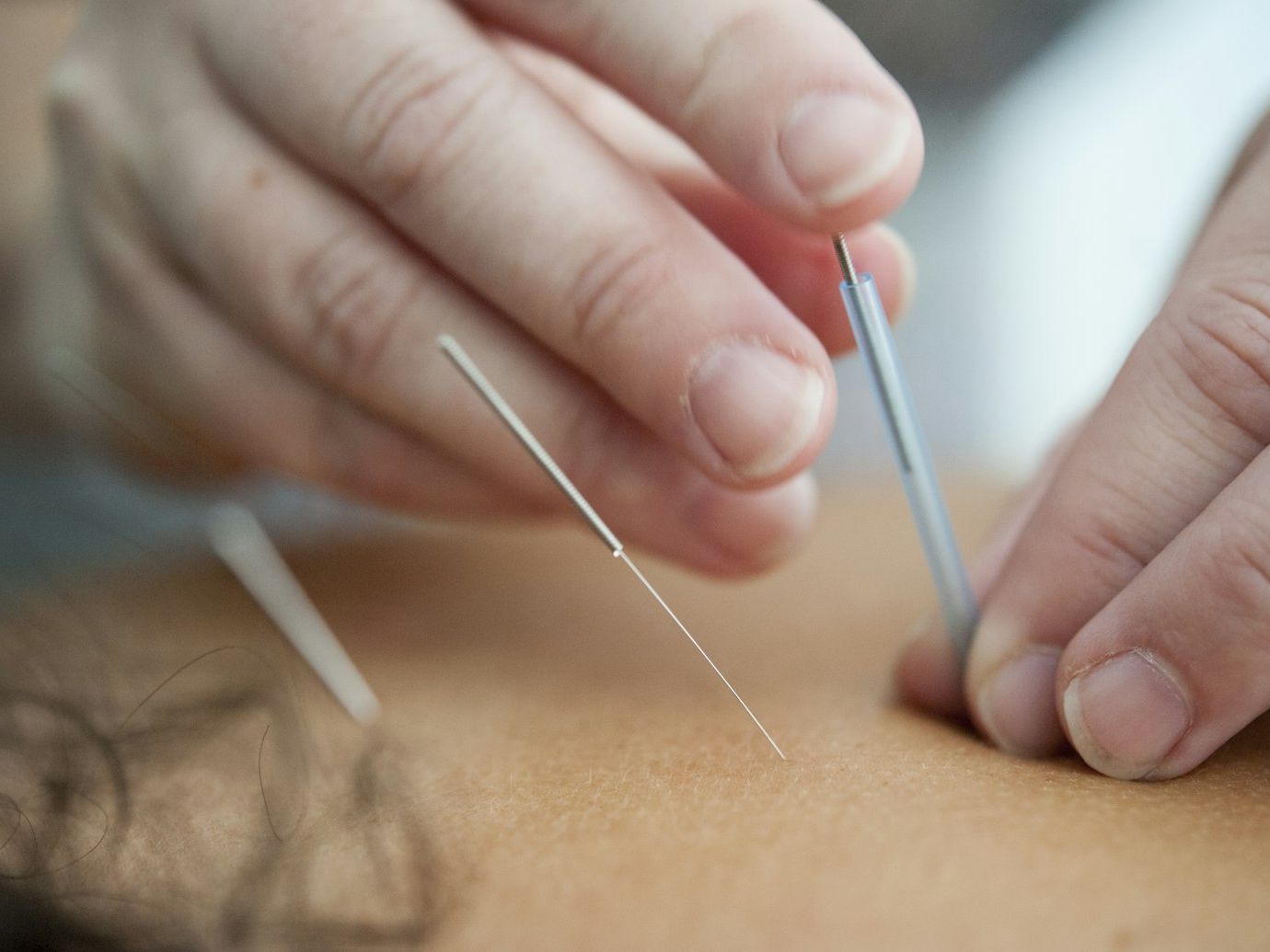
Like a Western physician, your acupuncturist begins with a history and examination — including traditional tongue and pulse diagnosis. From there, Dr. Lin decides which points to use, how long each session lasts (typically 20–45 minutes), how many sessions you need, and the method of stimulation.
- Needles of different lengths and gauges, inserted at a chosen depth and angle, then gently rotated, raised or vibrated.
- Electro-acupuncture — mild current passed through the needles.
- Cupping — suction to move blood and Qi.
- Moxibustion — the warmth of burning aged mugwort.
Points may be local (at the site of the problem), distal (elsewhere on the same meridian), or both. When a needle “obtains Qi,” patients feel a brief soreness, heaviness, swelling or tingling — a sign the point has been reached.
What science has found
Pain relief is the most studied use of acupuncture. Research suggests stimulation travels through the spinal cord to the brain, triggering the release of the body’s own pain-relieving chemicals — endorphins, enkephalins and dynorphin — and activating pathways that dampen pain signals. Acupuncture also appears to prompt anti-inflammatory hormonal responses.
Clinical studies support its use for low back pain, osteoarthritis, headache, menstrual cramps, tennis elbow, fibromyalgia, myofascial pain, carpal tunnel syndrome, asthma, stroke rehabilitation, addiction and post-operative nausea and dental pain.
Safety
Acupuncture has an excellent safety record compared with many standard therapies, and single-use disposable needles are now standard. Let Dr. Lin know if you are pregnant, have a bleeding disorder or take blood thinners, or have a history of cancer, so your treatment can be adjusted appropriately.