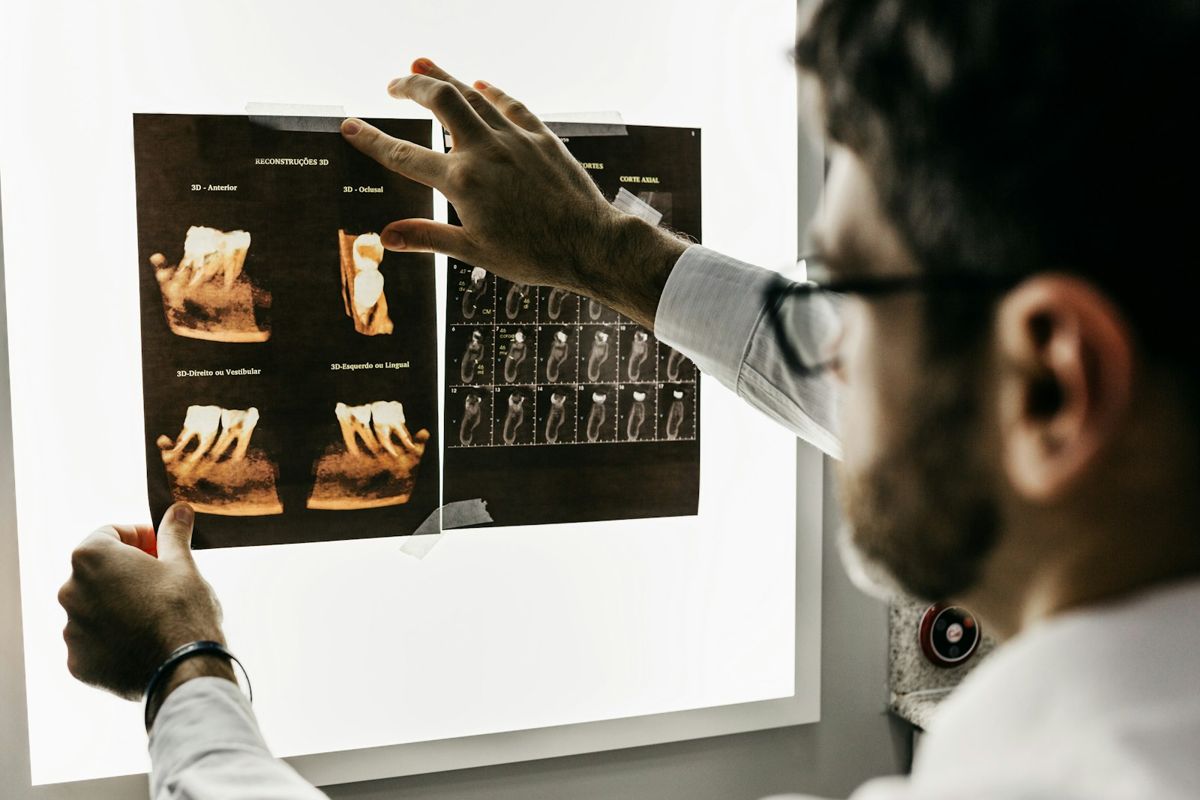
The most important part of maintaining your oral health is good daily hygiene paired with regular visits to our office. Routine visits allow Dr. Burris to diagnose problems early, monitor any areas of decay, and remove plaque that has built up over time.
Each maintenance visit includes a thorough cleaning, an assessment of your gums and soft tissues, and an oral cancer screening — when discovered early, nearly 90% of oral cancers are curable.
Maintenance cleaningsScaling & root planingOral cancer screeningDigital X-rays
When decay creates a cavity, a filling removes the damaged area and restores the tooth's shape and strength. We use durable, tooth-colored composite resin that's bonded directly to the tooth and shade-matched so it blends in naturally — no dark metal visible when you smile.
Composite fillings also require removing less healthy tooth structure than traditional fillings, helping keep your natural teeth stronger for longer.
When a tooth has too much damage for a filling but not enough to need a crown, an inlay or onlay is often the ideal middle ground. These custom restorations are crafted in a dental laboratory to fit your tooth precisely, then bonded in place.
An inlay fits within the cusps of a tooth, while an onlay extends over one or more cusps. Both preserve more natural tooth than a crown and are exceptionally long-lasting.
Teeth become cracked, chipped or discolored for many reasons, from trauma to everyday wear. When damage becomes significant, a custom-made crown restores the tooth's full strength, appearance and function.
Our porcelain crowns are fashioned by trained laboratory technicians, and the shade is carefully matched to your surrounding teeth using digital photography.
- Dr. Burris removes any decay, shapes the tooth and takes an impression of your bite.
- You leave with a comfortable temporary crown while your permanent crown is made.
- At your second visit, the final crown is checked for fit and bonded in place.
Bridges & Removable Partials
A fixed bridge replaces one or more missing teeth by anchoring a replacement tooth to crowns on the neighboring teeth. It restores your bite, keeps nearby teeth from drifting and fills the gap in your smile.
Removable partial dentures are a versatile, cost-conscious option for replacing several teeth. Dr. Burris will help you compare bridges, partials and implants to choose what's best for your health and budget.
Dental implants are, simply put, the most natural replacement for missing teeth. Our focus is replacing teeth with proven, minimally invasive techniques that restore function while maintaining jaw strength and a natural appearance.
Replacing a single tooth
Traditionally, the healthy teeth on either side of a gap were cut down to support a three-unit bridge. An implant instead replaces the missing tooth root. It fuses solidly with the jawbone (osseointegration), and a crown is placed on top that looks, feels and functions like a natural tooth.
Replacing several teeth
Removable dentures can slip, rub and make some foods hard to eat. Implant-supported dentures are firmly anchored to the jawbone, which helps prevent bone loss and feels much more like natural teeth.
Why patients choose implants: a success rate of nearly 98%, no reduction of healthy neighboring teeth, and protection against the bone loss that can change facial appearance.
Modern dentures look more natural and fit more comfortably than ever. We offer full dentures when all teeth in an arch need replacing, partial dentures to fill gaps, and specialty and implant-supported options for added stability.
Every set is custom-made to your mouth, and we'll fine-tune the fit so you can speak, smile and eat with confidence.
With age, and with coffee, tea, wine or tobacco, teeth gradually darken and stain. We offer two professional options to brighten your smile safely:
In-Office · Opalescence® Boost
Superior results in about an hour using a chemically activated formula — no heat or UV light. Up to 8 shades whiter, with potassium nitrate and fluoride to reduce sensitivity and strengthen enamel.
At-Home Whitening
Dr. Burris fits custom trays to your bite and provides a mild professional gel for you to use on your schedule. Typically 4–6 shades whiter.
Whitening isn't right for every type of discoloration. When it isn't, Dr. Burris can recommend restorative options like bonding or veneers.
Veneers are thin coverings applied to the front teeth to correct stains, chips, cracks, gaps or slightly crooked teeth.
Porcelain Veneers
Thin, durable shells made in a dental lab and bonded to the teeth. Only 0.5–1.0mm of enamel is typically reduced, and they often last well over 15 years.
Composite Veneers
Applied and sculpted directly in the office, often in a single visit. More affordable, with a typical life span of five to seven years.
Bonding & Composite Resins
Cosmetic bonding is a fast, conservative way to repair small chips, close minor gaps, reshape uneven edges or cover discoloration. A tooth-colored composite resin is applied, sculpted and hardened with a special light — usually in a single visit with little or no tooth reduction.
Combined with cosmetic contouring and gum recontouring for excessive gums, bonding can create a dramatic improvement with minimal treatment.
Whether it's football, hockey, basketball or soccer, a custom sports guard is one of the simplest ways to prevent chipped and knocked-out teeth and reduce the risk of jaw injury.
Unlike boil-and-bite guards from the store, ours are made from an impression of your teeth — so they fit securely, stay comfortable, and let athletes breathe and talk more easily.
A root canal treats infection in the soft inner tissue (pulp) of a tooth. Left untreated, these infections can spread, cause pain and discoloration, and affect the jaw and surrounding tissue.
Aren't root canals painful? Modern root canal therapy is usually painless — typically no more uncomfortable than having a filling placed.
- After numbing the area, Dr. Burris creates a small opening and removes decayed tissue and bacteria.
- The canals are carefully cleaned with the aid of magnification, then medicated to soothe the area.
- The tooth is sealed with a filling — and often a crown — to restore its strength.