

Sprinkler help and answers
Common questions, spring turn-on instructions and how-to videos for your controller and heads.
Seasonal service
When should I winterize my sprinkler system?
Before the first hard freeze. Our 2026 routes began September 22 and ran into November. Once freezing temps hit, it gets very difficult to clear the lines. Find your city’s dates.
How much does a winterization or spring start-up cost?
For 2026, either service is $100 for up to 9 zones on residential systems. Winterizations are $5 more per zone over 9, and $15 more for extra backflows. Lake, large well and commercial systems are priced separately.
What do I need to do before you come?
For a winterization, shut off the water to the sprinkler system in the basement and make sure we can reach the controller in the garage. Tell us about any spigot boxes or extra features, and send any codes we’ll need when you book.
How do I know when you’ll be in my city?
Fall and spring service notices go out by email, and dates are posted on our schedule page. If your city isn’t listed, contact the office with your preferred date and time slot.
How can I pay?
We accept checks, credit cards and cash, and payment is due at the time of service. Paying with cash saves $5. You can also prepay online.
Your system
Do I really need a rain sensor?
Yes. Minnesota law (Statute 103G.298) requires automatic landscape irrigation systems to have technology that interrupts watering during periods of sufficient moisture. A working rain sensor does that. We inspect it at every spring start-up.
Will you service a system you didn’t install?
Yes. We service all irrigation products, whether we installed the system or not.
How much should I water my lawn?
Most established Minnesota lawns do well with about an inch of water a week, counting rain. Water early in the morning and avoid running every day. We’ll set your controller at your start-up, and you can adjust it with the videos below.
Are there rebates for smart controllers?
Many metro cities have offered rebates on smart irrigation controllers through a Metropolitan Council water efficiency grant, including Brooklyn Park, Bloomington, Eden Prairie, Minnetonka and St. Louis Park. Programs usually cover replacements of older units and change from year to year, so check your city’s website.
New installations
Is the estimate free?
Yes. Rob does every estimate personally.
Will installation wreck my lawn?
No. A pipe puller slides pipe under the turf, and our pie cutter disc makes a clean slit that heals quickly. We use tarps and sod cutters where hand digging is needed.
Who handles permits and inspections?
We do. All licensing, fees and inspections are handled by Water Wizard, with licensed plumbing and low voltage electrical work.
How deep does the pipe go?
Typical pipe depth is 8” to 10”.
Spring turn-on instructions
Turning your own system on? Follow these steps at the backflow unit on the side of your house.
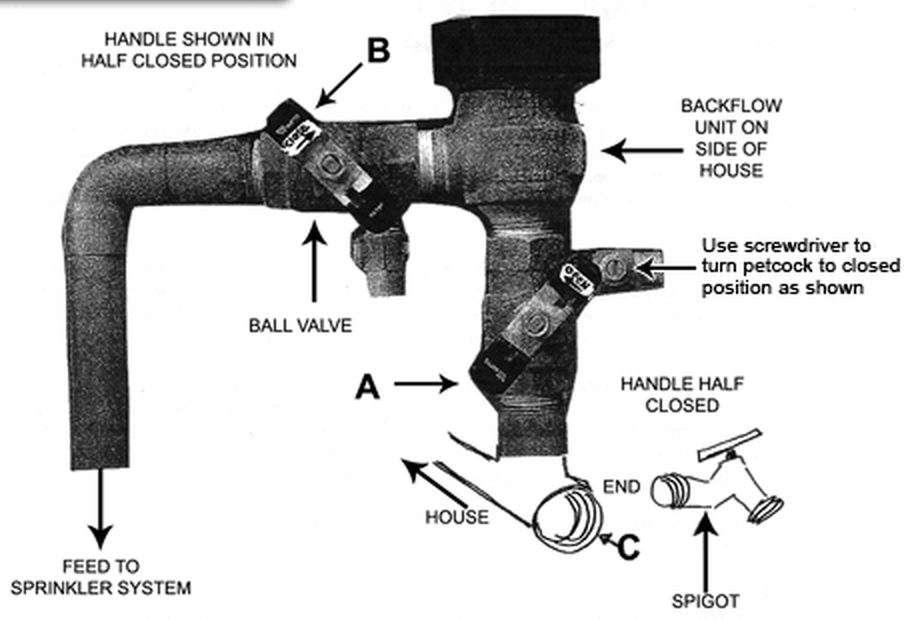
- Put Teflon tape on the end of the spigot. Screw it into C tightly, using pliers.
- Turn B clockwise to close the ball valve. The handle should be vertical.
- Turn A counter-clockwise to the open position. The handle should be vertical.
- Go into the house and turn on the water in the basement.
- Go back to your backflow and open B halfway, as pictured. You should hear water running through the pipes. Wait another 3 to 5 minutes after the water fills the lines, until you no longer hear rushing water.
- Run the controller zones, starting with zone 1 and working through each one. Make sure everything runs properly and you don’t have any repair needs.
- Set up your controller.
Hunter how-to videos
Short videos from Hunter on adjusting heads and programming your controller.